Heat Pump Underground + Cellar Siting UK 2026
Heat pump cellar siting UK 2026: when outdoor unit can go in basement with ducting, ventilation requirements, when it's viable + when it isn't.
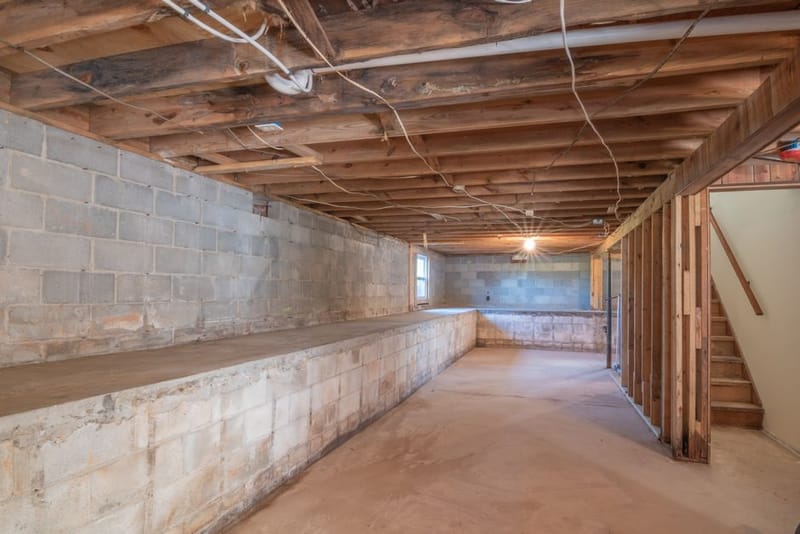
UK heat pump siting in basements or cellars sounds appealing for aesthetic reasons but is rarely viable for air-source units. This guide covers why standard monoblock installs need outdoor space, the ducting + ventilation challenges of indoor siting, and the alternatives for tight sites.
Why monoblock heat pumps need outdoor air
The fundamental thermodynamics.
Air-source heat pumps extract heat from outdoor air via a large heat exchanger + fan. The unit needs:
- Continuous outdoor airflow across the heat exchanger - typically 3,000-5,000 m3/hour at full load for a 7 kW heat pump.
- Air at ambient outdoor temperature - colder air = lower COP but still viable; warm recirculated indoor air = no useful heat extraction.
- Free exhaust path - the air leaves cooler than it entered (heat is extracted into the refrigerant). Recirculation back to intake = positive feedback loop, dropping efficiency to near-zero.
Putting a monoblock unit in an enclosed space (cellar, garage, basement) without adequate ducting violates all three requirements. The unit might run for a few hours then trip on low-pressure faults as the heat exchanger ices up + recirculated air can't deliver more heat.
The ducting solution - when it works (rarely)
Commercial multi-split with separated compressor.
Some commercial multi-split systems allow the heat pump's outdoor section to be enclosed with ducted air supply + return:
- Intake duct (300-500mm diameter): draws outdoor air from outside the building, delivers to heat exchanger.
- Exhaust duct (similar diameter): takes cooler air after heat exchange + vents back outside.
- Anti-recirculation design: intake + exhaust separated by 5m+ outdoor distance OR vertically displaced 3m+ to prevent feedback.
Ducting costs + efficiency penalties:
- Ducting install: GBP 2,000-5,000 for typical residential retrofit (depending on routing complexity).
- Efficiency penalty: 10-20% SCOP reduction vs equivalent outdoor monoblock (due to ducting friction losses, longer pipework heat losses, anti-recirculation challenges).
- Maintenance access: ducted units harder to service; engineer needs to disassemble ducting to access heat exchanger.
When justified: historic / listed buildings where outdoor unit visually unacceptable; commercial buildings with utility plant rooms; tight urban sites with NO outdoor space option. Rare in UK residential.
Ground-source heat pumps - the genuine 'underground' option
When 'heat pump in the basement' actually works.
Ground-source heat pumps (GSHP) are a legitimately 'underground' heat pump system - distinct from putting an air-source outdoor unit in a cellar.
- Borehole or ground loop: 50-150m deep borehole or extended horizontal loop in garden - extracts heat from ground (stable 10-12C year-round).
- Indoor manifold: sealed water loop from borehole connects to indoor heat pump unit (typically in plant room, utility, OR basement).
- Compressor + heat exchanger indoor: the heat pump's actual mechanical unit can legitimately sit in a basement plant room.
- No outdoor air dependency: heat comes from ground, not air - so indoor location works.
GSHP advantages:
- Excellent SCOP (4.0-5.0 typical) due to stable ground temperature.
- Indoor unit can be sited in basement / utility room without efficiency penalty.
- Silent operation (no outdoor fan).
GSHP disadvantages:
- Install cost much higher: GBP 25,000-40,000 pre-BUS for typical UK 3-bed.
- Garden disruption: borehole drilling or ground loop excavation.
- BUS grant available: GBP 7,500 (same as air-source).
- Installer specialism: fewer MCS-certified GSHP installers than ASHP.
For properties with no outdoor space for an air-source unit, GSHP is the practical alternative. Borehole option works even on tight urban sites (vertical drilling).
When buyers ask about cellar siting - common scenarios
Three patterns + the right answer.
- 'Can I put it in my garage to hide it?' No - garage is too enclosed for monoblock airflow. Would trip on low-pressure faults within hours. Best alternative: outdoor wall mounting on side of garage; ducting through garage wall is possible for some compact models but check installer's experience.
- 'Can I put it in my basement / cellar?' No for air-source monoblock. Possibly yes for GSHP (different system; indoor manifold legitimately sits in basement). For air-source, the unit MUST be outdoors.
- 'Can I cover the outdoor unit with an enclosure to hide it?' Acoustic screening yes (1.5m timber slat panel) - allows airflow + improves aesthetics. Full enclosure (sides + top) NO - blocks airflow + causes recirculation. Slat or louvre design only.
Alternatives for tight sites
What to do when outdoor space is limited.
- Wall mounting (smaller units only). Some compact R290 units (5-7 kW) suitable for wall mounting on external wall - saves ground space. Requires structural wall + careful airflow planning.
- Side passage siting. 0.8-1.2m wide side passage between properties; outdoor unit on concrete pad in passage. Common for terraced + semi-detached UK homes.
- Roof-level mounting (rare). Some flat-roof properties site the outdoor unit on the roof. Significant install complexity (crane access, structural reinforcement, electrical run). Cost ~GBP 1,500-3,000 premium.
- GSHP via borehole. Vertical drilling for borehole works on tight urban sites; indoor manifold + heat pump in basement / plant room. Higher install cost but solves tight-site air-source problem.
- Shared install (apartments, blocks). Larger commercial heat pump serving multiple flats via communal heating loop; outdoor unit in shared courtyard or roof. Less common for retrofit but increasingly used in new builds.