Air Source vs Ground Source Heat Pump: UK 2026 Guide
Air-source vs ground-source heat pumps for UK homes in 2026: install cost, real-world SCOP, space needs, BUS grant rules, and which suits which property.
For most UK households the air-source vs ground-source question has a default answer - air source - and the interesting question is the small set of cases where ground source genuinely beats it. Ground-source heat pumps run at higher real-world efficiency (SCOP roughly 4.0–4.5 vs 3.0–3.9 for air source), have a longer expected lifespan, and produce almost no audible outdoor noise. They also cost two to three times as much to install (£20,000–£30,000+ vs £8,000–£14,000), require either a substantial garden for slinky trenches or a borehole rig, and access the same £7,500 Boiler Upgrade Scheme grant as air source despite the larger spend. From 21 July 2026, an enhanced £9,000 grant applies where the heat pump replaces oil or LPG heating in an off-gas-grid home (England and Wales).
This guide is the honest engineering and economic comparison - what each technology actually delivers, where the cost gap goes, and which UK properties make ground source the right answer rather than the more expensive answer. Last reviewed: 15 May 2026.
1. How does each heat-pump system actually work?
Both technologies are refrigerant heat pumps. They use a compressor, a refrigerant cycle, and a heat exchanger to lift low-grade ambient heat up to the temperature needed to warm your home. The difference is where they pull that low-grade heat from.
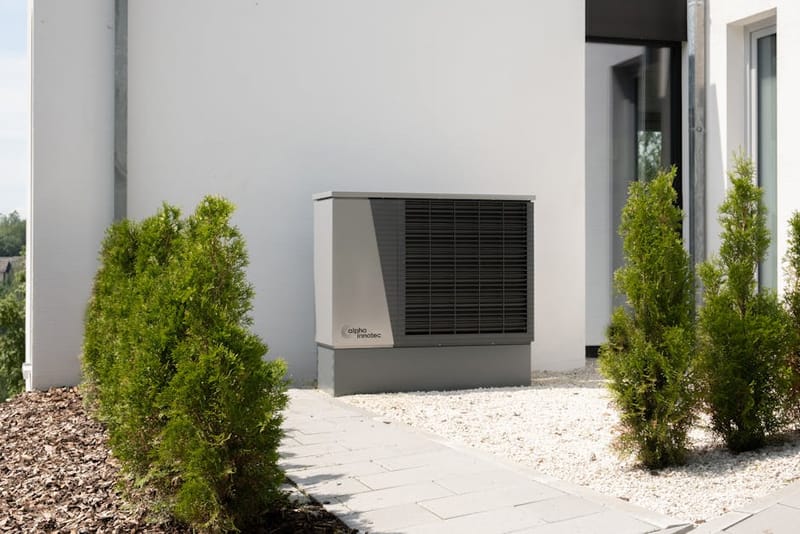
Air-source heat pumps (ASHP) extract heat from outdoor air. A fan pulls air across an evaporator coil; the refrigerant absorbs heat from the air even when outdoor temperatures are well below zero (commercial units rated to -25°C; UK design temperatures are typically -2°C to -4°C). The compressor then pressurises the refrigerant, raising its temperature, and a second heat exchanger transfers that heat into the house's heating circuit. The whole assembly lives in one outdoor unit roughly the size of a small wheelie bin (typically 70–90 cm tall, 80–110 cm wide) and a small indoor controller plus hot-water cylinder.
Ground-source heat pumps (GSHP) extract heat from the ground via a buried loop of pipe filled with a water-glycol mixture. Below about 1.5 m of depth the UK ground temperature is roughly constant at 10–12°C year-round, regardless of what the air is doing. That higher and more stable source temperature is the source of GSHP's efficiency advantage. The buried loop is either a horizontal ground collector - long shallow trenches (the "slinky" or straight-pipe configuration), needing 200–700 m² of garden depending on heat demand - or a vertical borehole, typically 80–150 m deep, drilled in a small footprint but requiring specialist rigging.
Critically, the indoor side of both systems is identical: the same hot-water cylinder, the same low-temperature radiators or underfloor heating, the same control strategy. If you've already engineered your home for ASHP-compatible flow temperatures and radiators, swapping the heat source from air to ground later is technically possible but rarely done because the install cost is dominated by the groundworks, not the indoor work.
2. Install cost - where the £12k–£20k gap goes
The install-cost gap is the single biggest factor in the comparison. For typical UK retrofits in 2026, MCS-installer quotes land in these ranges:
- Air-source heat pump: £8,000–£14,000 fully installed, before the £7,500 BUS grant. The typical 3-bed semi quote is around £11,000–£12,000. After grant, net cost is roughly £3,500–£6,500.
- Ground-source heat pump with horizontal collector: £20,000–£28,000 fully installed, before BUS. Net £12,500–£20,500 after grant.
- Ground-source heat pump with borehole: £25,000–£35,000+ fully installed, before BUS. Net £17,500–£27,500 after grant. Borehole drilling alone runs £8,000–£15,000 depending on geology and depth.
Where the £12,000–£20,000 gap comes from in the GSHP case:
- Excavation or drilling. Horizontal trenches need 1–1.5 m deep, 0.6–1 m wide, totalling several hundred metres of trench length. A two-day digger hire and the trench-and-backfill labour is typically £3,000–£6,000. Borehole drilling - vertical 100–150 m bores using a rotary rig - is £8,000–£15,000 and requires site access for the rig.
- The ground loop itself. Specialist PE100 pipe with high-density polyethylene fittings, manifolds, antifreeze fill, and pressure testing add £2,000–£4,000 in materials.
- The heat pump unit. GSHP indoor units are slightly more expensive than ASHP equivalents (£4,500–£7,500 vs £3,500–£5,500 trade) because the compressor and heat exchanger are sized for the higher continuous-duty cycle.
- Specialist install labour. Fewer installers do GSHP than ASHP, so lead times are longer and labour rates are typically higher.
The BUS grant is the same flat £7,500 regardless of which technology you choose, which mathematically favours the cheaper system - air source recovers a larger fraction of its installed cost.
3. Running cost - the SCOP comparison
SCOP (Seasonal Coefficient of Performance) measures the kWh of heat delivered per kWh of electricity consumed, averaged across a UK heating season. Higher is better. SCOP is the figure that determines running cost, not the laboratory-condition COP that manufacturers headline.
- Air-source SCOP, real-world: typically 3.0–3.9 in UK retrofits at 45–55°C flow temperatures. Nesta's monitoring of hundreds of UK installations finds an average around 3.9.
- Ground-source SCOP, real-world: typically 4.0–4.5 at the same flow temperatures. The stable 10–12°C ground temperature versus a UK air temperature that drops to -2°C or below means the compressor does less lifting work, especially on the coldest days when the air-source unit is at its least efficient.
- For underfloor heating designed at 30–35°C flow: both technologies climb. ASHP can reach SCOP 4.0–4.5; GSHP 4.5–5.0+. The relative gap stays roughly the same but absolute efficiency improves substantially.
At a UK electricity price of around 27p/kWh (May 2026, Ofgem cap) and a typical 12,000 kWh annual heat demand for a 3-bed semi:
- ASHP at SCOP 3.5: 3,430 kWh electricity ≈ £926/year.
- GSHP at SCOP 4.2: 2,860 kWh electricity ≈ £772/year.
The annual saving is around £150 - roughly £3,750 over 25 years (with electricity prices held flat in real terms; the actual saving depends on tariff trajectory). At a £15,000 install-cost premium for GSHP, simple payback on the additional spend is well over 100 years from the energy saving alone. The maths shifts if your property is larger, the BUS grant terms change, or you're on an economy tariff that lowers off-peak electricity prices to under 10p/kWh.
This is the central pragmatic point: GSHP is more efficient, but the install-cost premium is too large to recover via running-cost savings alone in most UK households. The case for GSHP rests on the non-energy reasons (noise, longevity, no outdoor unit, garden already being dug) rather than on payback.
4. Space requirements - the bottleneck most homes hit
Space is where the air-source-as-default conclusion comes from. Most UK properties don't have a viable footprint for a horizontal ground collector, and most owners don't want to fund a borehole when an ASHP alternative exists.
For air source: the outdoor unit needs roughly 1.5 m × 1 m of wall space or paved ground with 1 m airflow clearance to the front and 30–50 cm at the sides. Almost any UK property with a garden, side passage, or flat roof has somewhere viable. The constraint is usually planning (must not be on the front of the house, must meet the 42 dB(A) limit at neighbour's window) rather than physical space.
For ground source with horizontal collector: the rule of thumb is 200–300 m² of garden per 1 kW of heat-pump capacity for slinky configurations, or 300–700 m² for straight-pipe trenches. A typical UK 3-bed semi needs a 6–9 kW pump, so the garden requirement is roughly 1,500–2,500 m² for slinky or 1,800–4,500 m² for straight trenches - much larger than the typical UK suburban garden. The collector area must be open ground (lawn, agricultural land) without buildings, trees, or substantial paving on top, because the ground above the collector recharges its thermal store from rainfall and solar absorption.
For ground source with borehole: drilling needs ~3 m × 3 m of clear access for the rig and 80–150 m of vertical depth per bore. Multiple shallower bores can substitute for one deep bore. This works for sites with no garden but where the driveway or front courtyard can accommodate the rig and the long-term bore footprint. Urban Victorian terraces, blocks of flats with a shared front yard, and small new-build estates with no rear garden have all used boreholes successfully - at the cost premium noted above.
The honest summary: if your garden isn't visibly large enough that a friend would call it "a proper garden" rather than "a back yard", the slinky option is probably out. Borehole keeps GSHP on the table for any site that can host a drilling rig for a week.
5. The £7,500 BUS grant - equal access, unequal recovery
Both ASHP and GSHP are eligible for the same flat £7,500 grant under the Boiler Upgrade Scheme (Ofgem v5, running from 28 April 2026). The eligibility rules - owner-occupied property, valid EPC with no outstanding cavity-wall or loft insulation recommendations or evidence of why those measures aren't possible, MCS-certified installer, replacing fossil-fuel heating - apply identically to both technologies.
The economic effect is that the grant covers roughly 60–70% of a typical ASHP install but only 25–35% of a typical GSHP install. This is the single biggest reason most UK households who could technically choose either end up with air source.
If the BUS grant terms change - historically the scheme has been topped up and extended several times - the relative economics could shift. As of May 2026 the scheme is funded through to March 2028 and the per-installation grant has not changed since the 2024 increase from £5,000 to £7,500. See our Boiler Upgrade Scheme 2026 guide for the current rules and our BUS Guidance v5 explainer for the 28 April 2026 changes.
6. Lifespan, maintenance, and warranty
Lifespan is one of the few areas where the engineering case for ground source is unambiguous.
- Air-source heat pump units are typically rated for 15–20 years of service. The compressor and fan are the wear components; premium units (Vaillant aroTHERM Plus, Mitsubishi Ecodan, Daikin Altherma) carry 5–7 year warranties on the unit and 25-year warranties on the refrigerant cycle. Replacement at end-of-life means a new outdoor unit plus integration labour, typically £4,000–£7,000 in 2025/2026 prices.
- Ground-source heat pump units are typically rated for 20–25 years on the indoor unit (compressor and heat exchanger). The buried ground loop has an expected life of 50+ years - it sits below the frost line at a stable temperature with no UV, mechanical, or biological degradation. Replacing the indoor unit at year 20–25 is a £6,000–£10,000 job; the existing ground loop is reused without modification.
The 50-year ground-loop lifespan is what makes GSHP genuinely a 25–50 year investment rather than a 15–20 year one. If you're staying in the property long-term and value not having to redo the outdoor side of a heating system in your lifetime, this matters.
Annual maintenance is comparable between the two - £150–£250 for a service covering refrigerant pressure check, filter clean, and software/control review. Neither system requires the chimney sweep / corrosion inhibitor / flue check overhead of a gas boiler.
7. When ground source is actually the right answer
The set of UK households where GSHP is the right choice - not just "technically better" - is small but real. The honest list:
- You have a large garden and a 25-year horizon. The combination of running-cost saving, longer lifespan, and no outdoor unit becomes meaningful if you'll be in the property for the duration and have at least 1,500 m² of open ground. Family homes with substantial gardens, rural properties, and farmhouses fit this case.
- You're building new or extending substantially. If groundworks are already happening for foundations or a basement, the marginal cost of adding a ground loop is much smaller - often £4,000–£8,000 rather than the £8,000–£15,000 standalone trenching cost. New builds also size the heat distribution at design stage for low flow temperatures, lifting GSHP SCOP to its best 4.5–5.0+ range.
- Outdoor unit noise or visual impact is a genuine constraint. A small percentage of urban or sensitive sites - neighbouring listed buildings, party-wall arrangements that make placement awkward, Conservation Areas with limited permitted-development scope - make the outdoor air-source unit difficult enough to site that the borehole alternative is worth the cost premium.
- You're on a heat-pump-friendly off-peak tariff. If your electricity tariff drops to 7–10p/kWh overnight (Octopus Cosy, Intelligent Octopus, EDF GoElectric, etc.) and the heat-pump runs a thermal-store-and-cylinder strategy that loads heat overnight, the absolute running cost falls enough that the higher GSHP SCOP recovers a larger fraction of the install premium.
- You're an existing GSHP household replacing an older unit. If the ground loop already exists (typical for ~2010-vintage GSHP installs now needing indoor-unit replacement), the install-cost case completely flips - replacement is £6,000–£10,000 versus a fresh ASHP plus loop-abandonment.
8. When air source is the right answer (the default case)
For most UK retrofits - typical suburban semi-detached and terraced homes, modest gardens, owner-occupier households with a 10–15 year horizon - air source is the right answer for straightforward reasons:
- Install cost recovers via grant and energy saving. Net £3,500–£6,500 cost after BUS is comparable to a like-for-like premium gas-boiler replacement (£4,000–£6,000 for a high-end combi). Running cost is competitive with gas at typical UK tariffs.
- No major groundworks. The install is a 2–3 day job, mostly indoors. No digger, no borehole rig, no soil remediation. Disruption is limited to the small section of wall where the outdoor unit mounts.
- Most UK gardens or side passages have a viable outdoor-unit location. The 2025 easing of permitted-development rules (29 May 2025) reduced the planning friction substantially. The 42 dB(A) noise limit is met by most modern units at typical install distances.
- Substantial supplier choice. Vaillant, Mitsubishi, Daikin, Samsung, LG, Panasonic, and the BOXT/Heatable installer networks all do high-volume ASHP installs at competitive prices. GSHP has fewer suppliers and longer lead times.
- SCOP 3.5–3.9 is genuinely good. The headline efficiency advantage GSHP has over ASHP is real but small in pounds-and-pence terms. ASHP at 3.5 SCOP is roughly 350% efficient - 3.5 times better than a 100%-efficient electric resistance heater and roughly 3.5–4x better than the actual delivered-heat efficiency of a typical UK gas boiler (which is rated 90%+ at the meter but loses substantial heat to flue gases and distribution).
If you're trying to decide and you don't fit any of the "GSHP wins" cases above, the default-to-air-source heuristic is correct.
9. What real-world performance actually looks like
One final reality-check, because the marketing SCOP figures for both technologies oversell their winter performance.
Manufacturer-quoted ASHP SCOPs cluster at 4.5–5.1 in optimal conditions; Nesta's monitoring across hundreds of real UK installs finds an average closer to 3.9, with a substantial spread between well-engineered systems (SCOP 4.0+) and poorly-engineered systems (SCOP 2.5–3.0). The single biggest predictor of which side of that distribution a given install lands on is the heat-loss survey quality and radiator sizing, not the brand of pump.
For GSHP the same engineering caveat applies - a poorly-sized ground loop or a poorly-designed flow circuit underperforms. Well-engineered GSHP installs deliver SCOP 4.0–4.5 reliably; the headline 5.0+ figures depend on underfloor heating, well-insulated property, and benign ground conditions.
The 73% satisfaction figure that the Nesta survey finds for ASHP households is roughly mirrored in the smaller-sample GSHP literature - both technologies satisfy most owners when properly installed, and disappoint most owners when poorly installed. The install-quality variable matters more than the air-vs-ground choice.
Frequently asked questions
Which is more efficient - air source or ground source?
Do both qualify for the £7,500 Boiler Upgrade Scheme grant?
How much garden do I need for a ground-source heat pump?
What's the typical install cost for each in 2026?
How long do they last?
Which is quieter?
Can I convert an existing air-source install to ground source later?
Are there hybrid air-and-ground systems?
Which is better for a new build?
Decided which suits your home? Pick an installer next
For the 95% of UK households where air source is the right answer, BOXT and Heatable are the two volume installers most buyers compare. Our installer comparison walks through the trade-off in detail.