Heat Pump for Split-Level or Staggered Floor UK 2026
Heat pump split-level UK 2026: 1960s/70s staggered-floor houses; zone control complications; flow balance; recommended fixes.
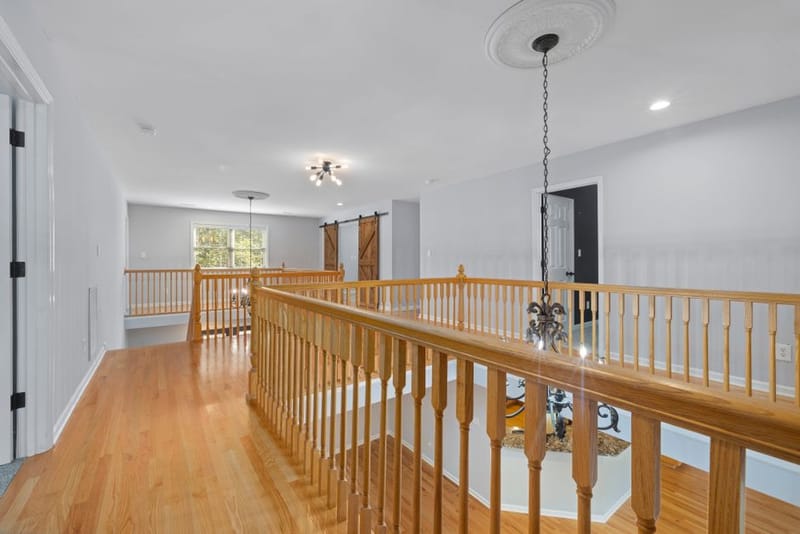
UK 1960s-70s split-level houses (half-floor staggered designs) are a notable retrofit segment. Around 100,000 such properties exist, mainly across South-East and Midlands suburban developments. This guide covers the install path.
What counts as a 'split-level' UK house?
Recognising the design pattern.
Split-level houses share these design features:
- Multiple half-floor levels: typically 3-4 levels rather than the standard 2-floor layout.
- Half-flight staircase between levels: 6-8 steps between levels (vs 12-14 steps full-flight).
- Entrance hall at ground level: kitchen often a half-flight up or down.
- Master bedroom and bathroom on upper levels: usually 1.5-2 floors up.
- Garage at ground or below-ground level: often integrated.
Common UK examples:
- 1960s-70s 'Span' developments by Eric Lyons (e.g. Blackheath, Cambridge).
- 1960s-70s suburban tri-level estate houses (common in commuter belt).
- 1970s 'half-acre' detached houses with split rear extension.
If the house has more than 2 distinct floor levels accessed by half-flight stairs, it's a split-level for heat pump install purposes.
Heat pump challenges specific to split-level homes
4 install considerations.
1. Uneven heat-loss per level:
- Lower (entrance / garage) level: cold, often partially below grade, high heat loss.
- Middle level: warmest, central, low heat loss.
- Upper level: hot air rises into here from middle level, gets too warm.
- Single thermostat in middle level = lower level cold, upper level overheating.
2. Pipework runs:
- Standard 22mm/28mm pipework runs vertical between half-floor levels.
- Each half-floor change = 1-2 extra bends + ~1.5m extra pipe.
- Total primary loop length 30-50% longer than equivalent flat 3-bed.
- Increased pump head demand - often requires secondary circulator.
3. Radiator sizing complexity:
- Lower-level radiators: 50-100% larger than equivalent room size in flat layout.
- Middle-level radiators: standard sizing or slightly smaller (warm air pooling).
- Upper-level radiators: often need TRVs to throttle when middle level is hot.
4. Thermostat placement:
- Single-zone thermostat positioning is impossible to satisfy all levels.
- Multi-zone control (3-4 thermostats) becomes necessary.
- Modulating boilers/heat pumps handle this better than on-off control.
Recommended install design
3-zone setup for typical split-level.
Zone 1 - Lower level (entrance, garage, hallway):
- Separate thermostat in the entrance hall.
- Larger radiators (calculated 130-150% of room area).
- Wider pipe drop (15mm minimum, not 10mm microbore).
- Heat-up priority - typically calls first as it's the coldest.
Zone 2 - Middle level (kitchen, living, dining):
- Standard thermostat in living room.
- Standard radiator sizing for room area.
- Often UFH retrofit candidate (entrance/dining/utility floor lift project).
Zone 3 - Upper level (bedrooms, bathroom):
- Bedroom thermostat (typically in master bedroom).
- Set-back temperature default (16-17C overnight vs 19-20C middle level).
- TRVs on every radiator for occupant-specific control.
- Often warmest zone passively - sometimes Zone 3 doesn't even need to call for heat.
Zoning controller options:
- Heat-pump-native 3-zone controller (Daikin Madoka, Vaillant SensoROOM): GBP 200-400.
- Universal smart thermostat with multiple zones (Drayton Wiser, Tado X): GBP 250-500.
- Includes hot water as 4th zone: standard.
Cost framework - split-level vs flat 3-bed install
Where the premium goes.
Baseline flat 3-bed 7-8 kW heat pump install: GBP 10,000-13,500 = GBP 2,500-6,000 net of BUS.
Split-level premium components:
- Extra primary pipework runs (vertical drops): GBP 400-800.
- Secondary circulator pump: GBP 300-500.
- 3-zone thermostat + valves: GBP 600-1,200.
- Larger lower-level radiators (50% upsize on 2-3 rads): GBP 400-800.
- Extended commissioning + balancing time: GBP 200-400.
- Premium total: GBP 1,900-3,700.
Total split-level install: GBP 11,900-17,200 pre-BUS = GBP 4,400-9,700 net of BUS grant.
Outdoor unit siting
Compact lots typical.
UK 1960s-70s split-level houses typically have smaller plots than equivalent-era detached homes. Outdoor unit siting options:
- Side passage (most common): 600-900mm wide between house and fence. Acoustic baffle required for neighbour separation < 4m.
- Lower-level integral garage external wall: ground-level mounting on garage wall; quiet because masonry absorbs vibration.
- Rear garden corner: standard but plot depth often 6-10m only, restrictive for outdoor distancing.
Most split-level homes have permitted-development rights for heat pump install (no listed status / conservation area issues). Planning permission rarely needed but verify locally.
Realistic SCOP expectations
What good split-level operation looks like.
- Poorly-designed install (single zone, fixed-output heat pump): SCOP 2.5-3.0. Significant comfort + bill issues.
- Standard 3-zone install (modulating heat pump, separate thermostats): SCOP 3.0-3.5. Acceptable.
- Premium 3-zone + UFH retrofit middle level: SCOP 3.4-3.8. Solid performance.
- Full envelope upgrade + premium zoning + UFH on 2 levels: SCOP 3.6-4.0. Excellent for split-level layout.
Split-level installs rarely match flat-layout SCOP scores due to the inherent flow-balancing complexity. SCOP 3.2-3.5 is a realistic 'good' install target.