Heat Pump for a Victorian Terrace UK: Suitability & Sizing
Victorian terraces are a UK heat-pump pain point - solid walls, small footprint, party walls. Insulation, sizing and high-temp options that actually work.

Victorian and Edwardian terraces account for around 14% of UK homes (a Victorian terrace is a brick-built mid-terrace house from 1837-1901 with solid walls, suspended timber floors, and shared party walls). The same features that make these properties desirable - high ceilings, original details, walkable urban locations - make them harder to heat with a low-temperature heat pump than the post-1970 cavity-wall housing stock that gets featured in most heat pump case studies. The good news is that the heat-pump retrofit path for a Victorian terrace is now well-mapped, BUS grant funding covers most of the wet-system upgrade, and several high-temperature heat pumps released in 2024-2025 can run on existing 60-70°C radiator designs while still hitting an SCOP above 3.5.
Can a heat pump actually work in a Victorian terrace?
Yes, but the order of operations matters more than for any other UK housing archetype. A heat pump sized for a pre-insulation Victorian terrace will be too big once the walls and floor are upgraded, leaving the system cycling badly and underperforming on efficiency. The MCS design standard - Microgeneration Certification Scheme, the UK industry standard required for BUS grant eligibility - requires the heat-loss survey to assume the planned fabric upgrades, not the current state.
The Energy Saving Trust's heat pump field trial (the Electrification of Heat demonstration project, run by Energy Systems Catapult for the Department for Energy Security and Net Zero) installed heat pumps in 742 UK homes including 89 pre-1919 terraces. The pre-1919 sub-cohort recorded a median SCOP of 2.8 versus 3.1 for post-1965 properties - lower but still well above the 1:1 efficiency of a gas boiler. SCOP is the Seasonal Coefficient of Performance, the ratio of heat output to electricity input averaged over a full heating season. The trial showed the SCOP gap closed substantially when fabric upgrades preceded the install.
What insulation does a Victorian terrace actually need before a heat pump?
The four fabric upgrades that move a Victorian terrace into heat-pump-ready territory:
- Loft insulation to 300mm (£300-£500 for an unconverted loft). The Building Regulations 2010 Part L target is 270mm; 300mm gives noticeably better performance at minimal extra cost. If the loft is already converted, the warm-roof upgrade is more expensive (£3,000-£7,000) but unlocks bedroom space.
- Wall insulation. Internal Wall Insulation (IWI) - a 60-100mm insulated plasterboard added to the inside face of external walls - is the most common option for terraces. Cost is £40-£90 per square metre, typically £6,000-£12,000 for a 3-bed terrace. External Wall Insulation (EWI) achieves better thermal performance but is usually restricted by conservation-area or street-elevation planning conditions on the street-facing wall. A compromise that works for many terraces is EWI to the rear wall (and party return) plus IWI to the front.
- Suspended floor insulation (£20-£40 per square metre). Most Victorian terraces have suspended timber floors over a ventilated sub-floor void. Insulating between joists with mineral wool or PIR (polyisocyanurate rigid foam) brings the floor U-value from ~0.7 to ~0.25 W/m²K. This is one of the highest-impact and lowest-cost upgrades.
- Double-glazing or secondary glazing. Original single-glazed sashes are often kept for character or required to be kept in conservation areas. Slim-profile double-glazing units (~14mm) fit most original sash frames and bring the U-value from ~5.0 to ~1.6 W/m²K. Secondary glazing is the cheaper, fully-reversible option at £200-£400 per window.
The combined fabric upgrades typically take a 3-bed mid-terrace's calculated heat loss from 9-11 kW (uninsulated) down to 5-7 kW. That's the difference between needing a 12 kW Daikin or Mitsubishi unit and a 6 kW unit that fits in the yard.
What size heat pump does a typical Victorian terrace need?
- 2-bed Victorian mid-terrace (~75 m²)
- Heat loss 4-6 kW → 5 kW heat pump (Daikin Altherma 3 R 4, Mitsubishi PUZ-WM50, Vaillant aroTHERM plus 5)
- 3-bed Victorian mid-terrace (~95 m²)
- Heat loss 5-7 kW → 6-8 kW heat pump (Daikin Altherma 3 R 6, Mitsubishi PUZ-WM85, Vaillant aroTHERM plus 7)
- 3-bed Victorian end-terrace (~100 m²)
- Heat loss 7-9 kW → 8 kW heat pump (one extra exposed wall = +1.5-2 kW)
- 4-bed Victorian end-terrace (~120 m²)
- Heat loss 8-11 kW → 10-12 kW heat pump (sized for low-temperature flow at design conditions)
The figures assume insulation upgrades to a target fabric performance of: walls at 0.30 W/m²K (achievable with 80-100mm IWI), floor 0.25 W/m²K, loft 0.16 W/m²K, glazing 1.6 W/m²K. The MCS designer will use the BS EN 12831 calculation method against your local design external temperature (typically -2°C to -4°C in most of England, -5°C to -6°C in Scotland) and a 21°C internal living-room target.
What if the rear yard is too small for the outdoor unit?
This is the single most common reason Victorian terrace heat-pump installs fall through. The MCS installer needs to leave 200-300mm clearance to walls and 1-1.5m of clear discharge airflow in front of the unit. Most 5-7 kW outdoor units have a footprint around 1.1m wide × 0.4m deep × 0.8-1.0m tall and need a 1m discharge zone. That's a 1.1 × 1.4m minimum footprint - tight in a 2m × 3m yard but usually possible.
Three options when the yard genuinely won't fit a standard unit:
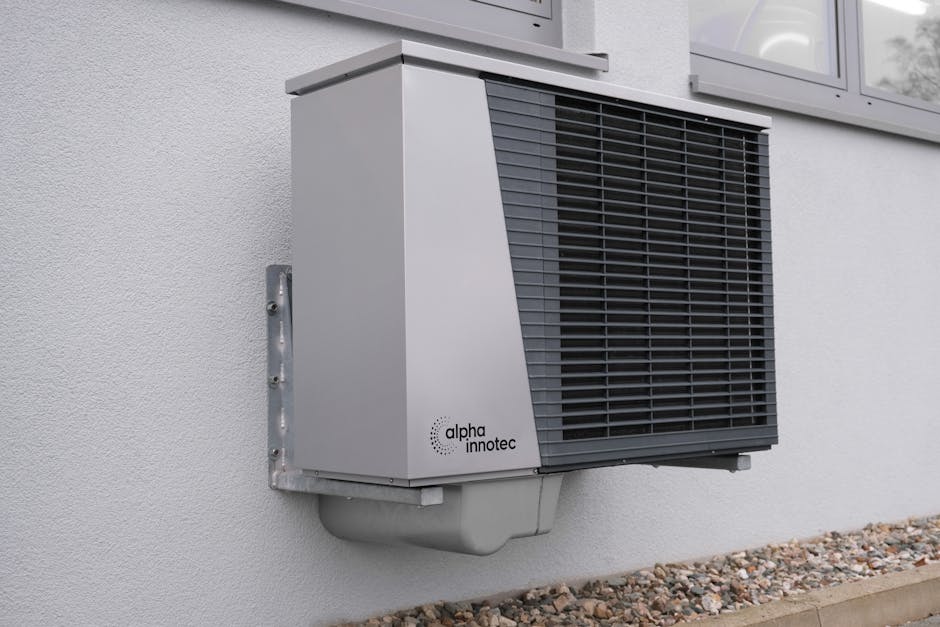
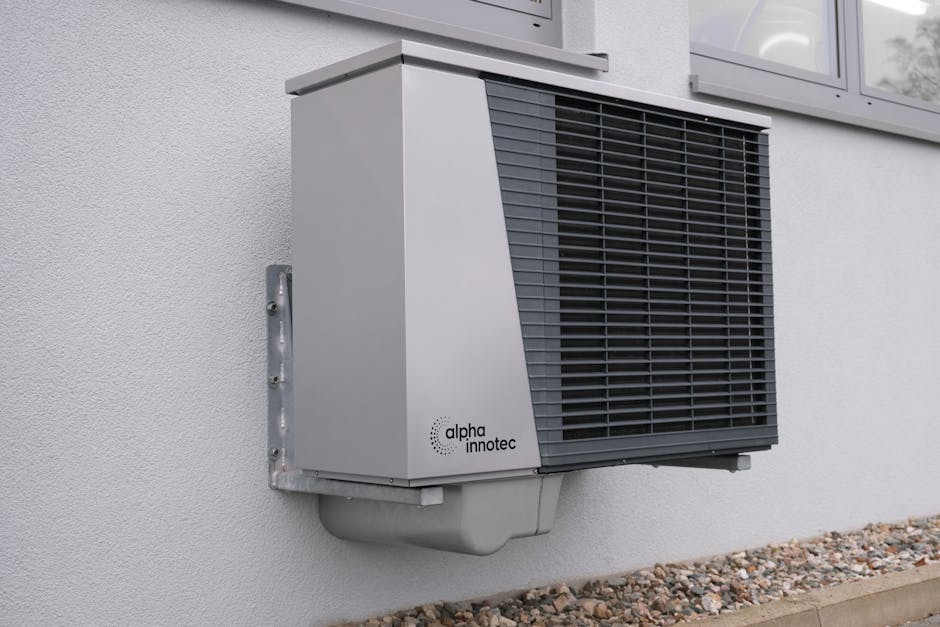
- Wall-hung mounting. Vaillant, Daikin and Bosch all sell wall brackets rated for the outdoor unit weight (70-110 kg). The unit mounts at first-floor height on the rear elevation, freeing the yard floor entirely. Acoustic considerations are higher (you're closer to bedroom windows) so the unit must be a low-noise model in night-mode.
- Front-garden installation. Permitted Development rights for heat pumps were expanded in May 2024 to remove the previous 1m boundary distance rule and the 5 kW power cap for single units, but the unit must still be at least 1m from the boundary in a Conservation Area. For most non-conservation terraces a front-garden install is now feasible if planning permits and the visual impact is acceptable. Check the government Permitted Development guidance for heat pumps.
- High-temperature heat pump on existing radiators. If the yard is too small for the larger 8-10 kW unit you'd otherwise need, a high-temperature unit (Vaillant aroTHERM plus 75°C, Daikin Altherma 3 H HT 80°C) lets you keep the existing radiator design without the upsizing burden. SCOP drops to 2.8-3.2 rather than 3.5-4.0, but you avoid the radiator works and the system fits the smaller outdoor unit envelope.
Which heat pump models suit Victorian terraces best?
Three models that consistently come up in MCS-installer recommendations for Victorian terraces:
Daikin Altherma 3 R (4-8 kW). Compact outdoor unit (1.0 × 0.41 × 0.94m), R32 refrigerant, monobloc design (no indoor pipework charged with refrigerant - the F-gas leak risk and certification burden stays outside). Flow temperatures up to 60°C nominal, 65°C in domestic-hot-water mode. SCOP 4.0 at 35°C flow, 3.4 at 45°C. The Altherma 3 R is the most-installed unit in Octopus Energy's Cosy Octopus heat-pump trial.
Vaillant aroTHERM plus (3-12 kW). The 'plus' model uses R290 (propane) refrigerant, achieves higher flow temperatures (up to 75°C in DHW mode) than R32 alternatives, and has one of the lowest sound power ratings in the UK market at 54-58 dB(A). The 5 and 7 kW units are the typical Victorian terrace fits.
Mitsubishi Ecodan PUZ-WM (5-11 kW). Long-established UK presence, wide MCS installer network. The PUZ-WM85 (8 kW) is the workhorse for 3-bed Victorian terraces. SCOP 3.5 at 45°C flow. The Ecodan FTC6 controller has solid weather compensation built in - important for solid-wall homes where outdoor temperature changes show up in the indoor environment faster than in cavity-walled properties.
What does the BUS grant cover for a Victorian terrace retrofit?
The Boiler Upgrade Scheme (BUS), administered by Ofgem and funded by the Department for Energy Security and Net Zero, currently offers £7,500 toward an air-source heat pump installation in England and Wales (raised from £5,000 in October 2023; comparable schemes exist in Scotland via Home Energy Scotland, paying up to £15,000 in interest-free loan plus £9,000 grant). The grant is paid to the MCS-certified installer who claims it on your behalf - you see the net price.
Critically: the BUS grant covers only the heat pump and the associated wet-system work (radiator upsizing, cylinder, pipework). It does NOT cover insulation, glazing, or the fabric upgrades a Victorian terrace needs first. Those are funded separately through the Energy Company Obligation (ECO4) for lower-income households, or the Green Deal-type private-finance products. A realistic 3-bed Victorian terrace heat-pump retrofit budget is:
- Insulation upgrades: £8,000-£15,000 (IWI to rear and front, suspended floor, loft top-up)
- Wet-system upgrades: £2,000-£4,000 (radiator upsizing, weather compensation control)
- Heat pump install (gross): £10,000-£14,000
- BUS grant: -£7,500
- Net total: £12,500-£25,500
The economics depend on what the gas-boiler counterfactual is. A new combi-boiler install at £3,000-£4,000 every 10-15 years is the comparison; heat-pump running costs drop further as electricity prices fall relative to gas through 2030 under the government's stated rebalancing policy.
Frequently asked questions
Q01Can I install a heat pump in a Victorian terrace without insulating first?
Q02Do I need planning permission for a heat pump in a Victorian terrace?
Q03Will a heat pump heat my Victorian terrace as warmly as my gas boiler does?
Q04What's the SCOP I should expect from a Victorian terrace heat pump?
Q05Can a high-temperature heat pump skip the radiator upsizing?
Q06Is the noise an issue in a Victorian terrace yard?
Is My Home Suitable for a Heat Pump?
Best Heat Pump for a 3-Bed Semi UK
Heat Pump Oversizing Problem