Heat Pump for Back-to-Back Terrace UK 2026
Heat pump back-to-back terrace UK 2026: northern English terraces, no rear access, shared walls, outdoor unit siting challenges.
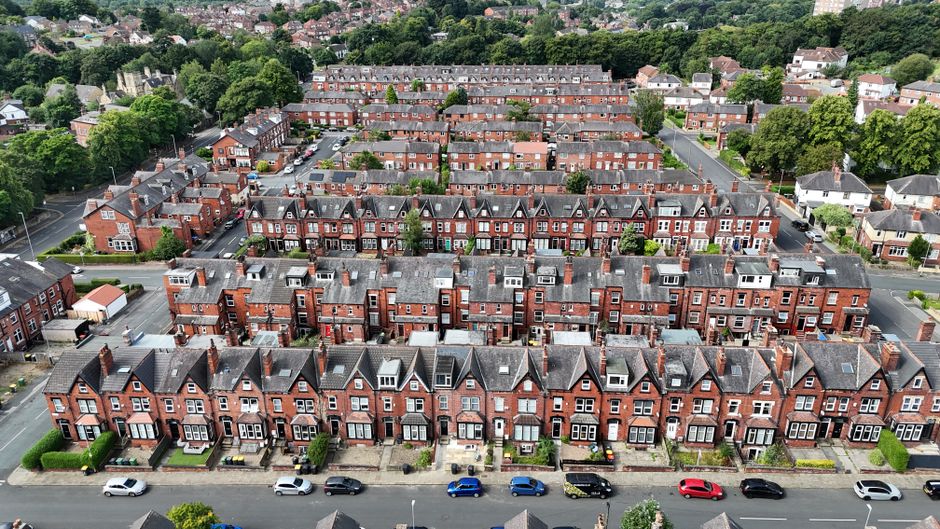
Back-to-back terraces in West Yorkshire and Lancashire are among the most challenging UK heat pump retrofits. Around 50,000+ such properties remain (mostly Leeds, Bradford, Halifax, Bolton). This guide covers the install path.
What 'back-to-back' actually means
Construction characteristics.
Back-to-back terraces are a specific Victorian construction type, predominantly built 1840-1910 in northern English industrial cities:
- Houses share rear wall with another row: 5 of 6 wall faces are shared with neighbours.
- Only front-street access: no rear garden, no side passage.
- Small footprint: 60-90m2 typical 2-bed or 3-bed (much smaller than equivalent-era mid-terrace).
- Solid 9-inch brick walls: U-value 1.5-2.0 W/m2K for the few external surfaces.
- Yorkshire stone or slate roof: simple pitched roof.
- Cellar typically present: original household coal cellar, now often converted to storage / kitchen.
- Single-aspect home: all windows face front street only.
- Conservation Area protection: many in protected streetscape (Leeds Holbeck, Bradford Listerhills, etc.).
Heat loss is actually low
The advantage of 5 shared walls.
Counter-intuitively, back-to-back terraces have LOWER heat loss than equivalent mid-terrace homes (despite uninsulated brick walls):
- Surface area math: only front wall + roof + ground floor are exterior. Side + rear walls all party (neighbours heat from other side = ~zero loss).
- Typical heat-loss surfaces: 25-35m2 front wall + 30-40m2 ground floor + 30-40m2 roof = 85-115m2 total exterior.
- Compare to mid-terrace: front wall + rear wall + ground floor + roof = 110-150m2 exterior.
- Compare to end-of-terrace: 3 walls + ground + roof = 130-170m2 exterior.
Heat-load implications:
- Back-to-back 2-bed 70m2: 3.5-5 kW peak heat load.
- Back-to-back 3-bed 90m2: 4.5-6 kW peak heat load.
- Smaller heat pump (5-6 kW typical) sufficient.
- If front wall insulated (EWI): 3.5-5 kW typical.
Outdoor unit siting - the main challenge
Where to put it.
Back-to-backs have severely constrained outdoor unit siting. Options in order of likelihood:
Option 1 - Front yard/garden (if present):
- Some back-to-backs have small front yards (1-3m deep) where the original coal-cellar window-light was located.
- Most viable option if available.
- Planning permission required in Conservation Area (almost always the case).
- Acoustic screening + visual screening typically required for consent.
Option 2 - Front basement window-light (cellar conversion):
- If the cellar is being or has been converted, the basement window-light area can accommodate a small outdoor unit.
- Below pavement level → less visually intrusive.
- Requires drainage + structural assessment.
Option 3 - Loft / roof (rare):
- Outdoor unit mounted on flat roof of loft conversion / dormer extension.
- Acceptable in some streets but very visible from below.
- Refrigerant pipework long (full house height).
Option 4 - Front wall (not recommended):
- Mounted directly on the brick front facade.
- Visually intrusive; almost always refused in Conservation Area.
- Last-resort only with conservation officer pre-approval.
Option 5 - Not permitted:
- Rear/party walls (would require neighbouring property consent + access through their land).
- On the street pavement (not your property).
Listed building / conservation area planning
Required for almost all back-to-backs.
Process for typical Leeds Holbeck or Bradford Listerhills back-to-back:
- Pre-application consultation with Conservation Officer (free; 4-6 weeks).
- Formal planning application for outdoor unit + any visible pipework (GBP 250-450 fee).
- Listed Building Consent if individually listed (~5-10% of back-to-backs).
- Decision time: 8-12 weeks typical.
- Common conditions: acoustic enclosure, visual screening (planted screen or matching-brick housing), siting at ground level not mid-facade.
Realistic success rate (Leeds/Bradford):
- Front yard siting: ~70% approval rate.
- Front wall direct mount: ~20% approval rate (refused on visual amenity grounds).
- Outdoor unit on extension/loft: ~50% (depends on visibility from public viewpoint).
Cost framework - back-to-back vs typical 3-bed
Where the premium goes.
Typical back-to-back install:
- 5-6 kW heat pump unit: GBP 7,500-9,500.
- 200L unvented cylinder: GBP 1,200-1,700.
- Pipework + commissioning: GBP 1,500-2,500.
- Planning permission + Conservation Officer consultation: GBP 250-450 + GBP 500-1,500 (architect or consultant).
- Acoustic enclosure (custom): GBP 1,000-2,500.
- Front wall EWI (recommended if budget): GBP 3,000-5,000.
- BUS grant: -GBP 7,500.
- Net total: GBP 7,450-15,650.
Premium of GBP 1,500-3,500 above typical UK 3-bed install reflects planning consent + constrained siting + acoustic enclosure.
Realistic SCOP for back-to-back
Actually quite good when achievable.
- Standard back-to-back, uninsulated: SCOP 3.0-3.4. Acceptable - low heat load helps SCOP despite poor envelope.
- With front wall EWI: SCOP 3.4-3.7.
- With EWI + double-glazed front + insulated cellar floor: SCOP 3.6-3.9.
Back-to-back terraces can actually achieve solid SCOP because the small heat load means heat pump operates in its efficient mid-modulation range most of the time.